
A key part of the training journey.
The terminal at Narita Airport felt like the start of a new chapter for me. As I walked through the sliding glass doors, the cold Japanese air hitting my face, I gripped my suitcase a little tighter. Inside were my notebooks, my laptop, and the expectations of my colleagues back at Apex Footwear. My name is Rafiqul, and I had been selected for a deep-dive training on automated production and lean management—a journey that would take me from the heart of the factory to the soul of Japan.
The Precision of the Morning
My mornings began in the industrial suburbs of Nagoya, a place where efficiency isn’t just a goal; it’s a religion. In the training center, the floors were so clean they reflected the overhead lights like a mirror.
I spent hours huddled over blueprints with Japanese engineers. We talked about the $3M$—Muda (waste), Mura (unevenness), and Muri (overburden). I remember standing by a robotic stitching arm, watching it move with a grace that felt almost human. I thought about our production lines in Bangladesh—the heat, the rhythmic hum of the machines, and the hardworking hands of our artisans. I realized that my job wasn't just to bring back "technology," but to bring back the discipline of perfection. Every stitch on an Apex shoe had to be a promise kept to the customer.
The Soul of the Afternoon
But when the clock struck five and the factory hum subsided, I became a student of a different kind. I realized that to truly understand Japanese quality, you have to see how they live.
I took the Shinkansen—the bullet train—to Kyoto. As the train accelerated to its top speed, the tea fields outside the window became a green blur. I sat there, looking at my own shoes, thinking about the thousands of miles they would travel. In Kyoto, I walked through the Arashiyama Bamboo Grove. The towering stalks swayed in the wind, creating a sound like a soft wooden whistle. I walked for hours, my feet feeling the terrain, testing the very comfort we strive to engineer every day at Apex.
I met an elderly cobbler in a side street near Gion. He didn't speak much English, and my Japanese was limited to "Arigato," but we spoke the language of leather. He showed me a pair of traditional sandals he was repairing, his hands calloused but steady. In that moment, the distance between Dhaka and Kyoto vanished. We were both just craftsmen trying to make the world’s journey a little more comfortable.
The Neon Reflection
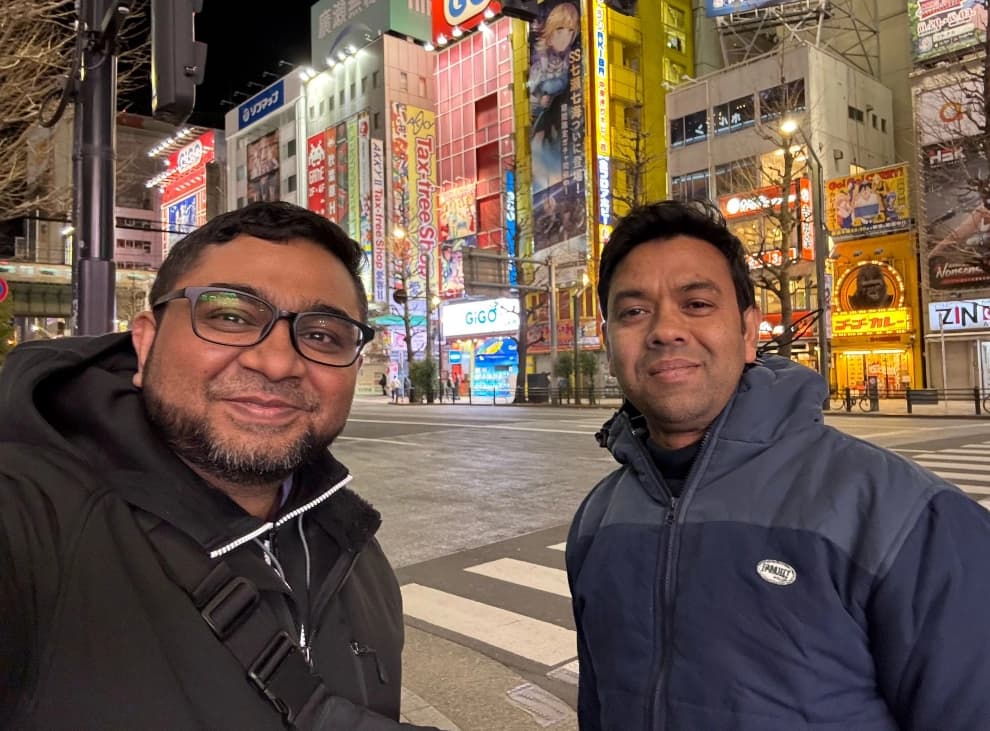
My final weekend was spent in the sensory overload of Tokyo. Standing at the center of the Shibuya Crossing, surrounded by three thousand people crossing at once, I felt a surge of pride. I saw a sea of footwear—elegant heels, rugged boots, sleek sneakers. I imagined a future where the shoes designed in our boardroom at Apex were walking these very streets, holding their own against the best in the world.
One evening, I hiked a trail near the base of Mount Fuji. The air was thin and crisp. As the sun began to set, painting the snow-capped peak in shades of violet and gold, I took a moment of silence. I thought about my family back home and my team at the factory. I wasn't just Rafiqul, the trainee; I was an ambassador.
The Return
Now, as I sit in my hotel room packing, my suitcase is heavy. It’s filled with technical manuals on "Kaizen" and "Six Sigma," yes, but it’s also filled with the spirit of the places I’ve seen. I’m bringing back a piece of the Japanese quiet, their relentless pursuit of the "Better," and a vision for Apex that spans far beyond our borders.
I came here to learn how to build better shoes, but I think I learned something more important: I learned that every journey—whether it’s across a factory floor or across the world—starts with the right step.